
If you’re considering straightening your teeth, you’ve probably already landed on the same question most Langley patients ask first: Invisalign or traditional braces? Both move teeth into better alignment, but they get there in very different ways — and the right choice depends on your bite, your lifestyle, and your budget.
This guide breaks down the real differences between clear aligners and traditional braces, so you can walk into your consultation at North Langley Family Dental already knowing what to ask.
What Is Invisalign?
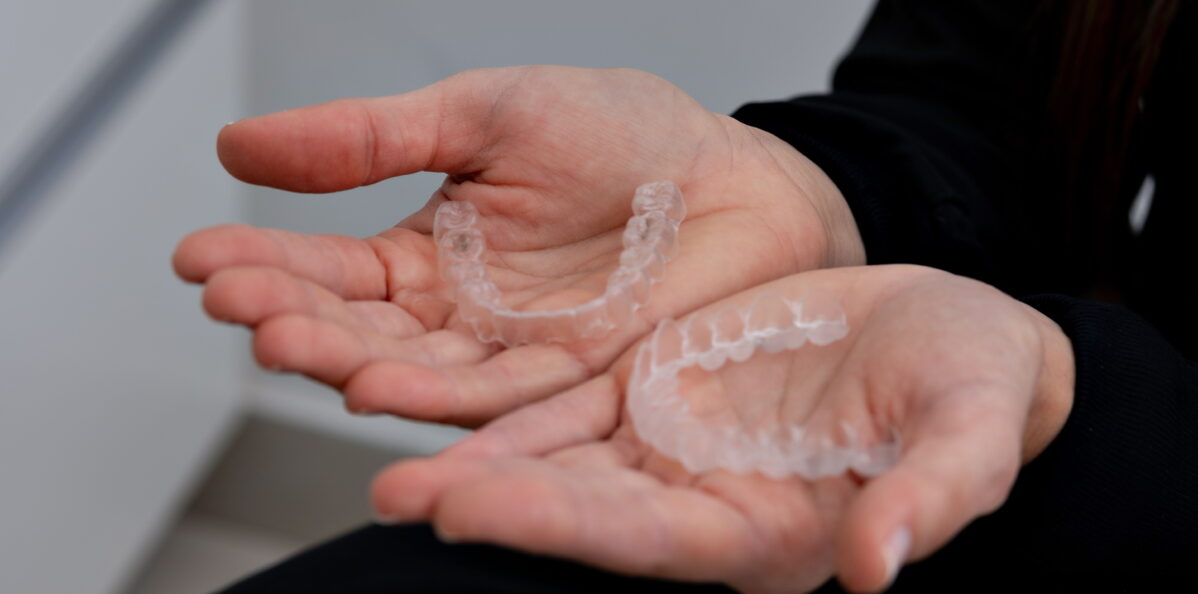
Invisalign uses a series of clear, custom-molded plastic aligners that gradually shift your teeth into position. You wear each set for about one to two weeks before switching to the next in the sequence, swapping aligners roughly every 20 to 30 tray changes depending on your treatment plan. The aligners are removable, virtually invisible, and require no metal brackets or wires.
Because they’re removable, Invisalign works well for patients who want to keep eating, brushing, and flossing without extra equipment in the way — but that same flexibility means results depend on wearing them consistently (typically 20–22 hours a day).
What Are Traditional Braces?
Traditional braces use metal (or ceramic) brackets bonded to each tooth, connected by an archwire that your dentist or orthodontist tightens at regular visits. Unlike Invisalign, braces stay on your teeth the entire time — there’s no removing them to eat or for a big event — which takes the guesswork out of compliance. For more complex bite issues, braces still offer a level of control that clear aligners can’t always match.
Key Differences at a Glance
| Invisalign | Traditional Braces | |
|---|---|---|
| Visibility | Nearly invisible | Visible metal or ceramic brackets |
| Removable | Yes — for eating, brushing, flossing | No — fixed to teeth throughout treatment |
| Average treatment time | 12–18 months for moderate cases | 18–24 months, longer for complex cases |
| Best for | Mild to moderate misalignment | Mild to severe misalignment, complex bite issues |
| Maintenance | Clean trays, no food restrictions | Avoid sticky/hard foods, more careful brushing |
| Compliance required | High — must wear 20–22 hrs/day | Low — always on, no patient discipline needed |
Cost Comparison in Langley
Cost is one of the first questions most patients ask, and the honest answer is: it depends on your case, not just which option you pick. Straightforward cases can bring Invisalign and traditional braces into a similar price range; more complex bite corrections tend to push Invisalign’s cost higher, since it can require more aligner trays and check-ins over a longer timeline.
The only way to get an accurate number is a consultation and a look at your bite — general online price ranges are a starting point, not a quote. If cost is your biggest factor, ask about it directly: see our full breakdown in Invisalign Cost in Langley: What Affects Your Price for the specific factors that move the number up or down.
Worth knowing: the Canadian Dental Care Plan (CDCP) does not currently cover orthodontic treatment, including Invisalign or braces, for most adult patients. If CDCP coverage is part of your planning, see our guide on what CDCP does and doesn’t cover before booking.
Treatment Time — How Long Does Each Take?
For mild-to-moderate cases, Invisalign often finishes in 12 to 18 months. Traditional braces typically run 18 to 24 months, though timelines stretch for more complex bite corrections regardless of which option you choose. Two things affect treatment time more than the technology itself: how much movement your teeth need, and — for Invisalign specifically — how consistently you wear your aligners. Skipped hours add up to a longer timeline.
Comfort and Lifestyle Considerations
Invisalign trays have smooth edges and no wires, so most patients find them more comfortable day-to-day, with mild pressure for a day or two after switching trays. Braces can cause more noticeable irritation to the cheeks and lips, especially in the first few weeks, and require avoiding sticky or hard foods (think caramel, popcorn, ice) for the full treatment period.
On the flip side, braces need zero daily discipline — there’s nothing to remember to put back in after a meal. If you know you’d struggle to keep aligners in for 20+ hours a day, that’s worth being honest with yourself about before choosing Invisalign.
Who Is a Good Candidate for Invisalign vs. Braces?
Invisalign tends to work well for:
- Mild to moderate crowding or spacing
- Adults and teens who want a less visible option
- Patients who are disciplined about wearing removable appliances consistently
- Cases without significant bite (jaw alignment) issues
Traditional braces tend to work better for:
- More severe crowding, spacing, or rotation
- Complex bite issues — significant overbite, underbite, or crossbite
- Younger patients who may not reliably wear removable aligners
- Cases needing precise, continuous force that fixed brackets provide
If your case involves a complex bite, don’t rule either option out based on a guess — read Choosing an Orthodontist for Complex Bite Issues or book a consultation so we can look at your specific bite and tell you honestly which approach will get you the best result.
Which Option Is Right for You?
There’s no universally “better” choice between Invisalign and traditional braces — there’s only the better choice for your bite, your timeline, and how you live day to day. A consultation with X-rays and a bite assessment is the only reliable way to know which one will get you to a straighter smile faster and more predictably.
Book a Consultation at North Langley Family Dental
Whether you’re leaning toward Invisalign or want to talk through whether traditional braces make more sense for your bite, our team can walk you through both options and what to expect for your specific case. We serve patients across Langley Township, Walnut Grove, Willowbrook, Brookswood, Fort Langley, and nearby communities in Maple Ridge and Aldergrove.
Call us at 604-888-6885 or contact us online to book your orthodontic consultation.
Frequently Asked Questions
Is Invisalign more expensive than traditional braces?
It depends on the complexity of your case rather than the technology itself. Straightforward cases often land in a similar price range for both options; more complex bite corrections can push Invisalign’s cost higher due to a longer treatment timeline. A consultation is the only way to get an accurate comparison for your specific bite.
How long does Invisalign take compared to braces?
Invisalign typically takes 12 to 18 months for mild-to-moderate cases, while traditional braces usually run 18 to 24 months. Both timelines extend for more complex bite corrections, and Invisalign’s timeline also depends on wearing aligners consistently for 20-22 hours a day.
Can adults get Invisalign in Langley?
Yes. Invisalign is a popular option for adults specifically because it’s far less visible than traditional braces, which matters for patients in professional or public-facing roles. Age isn’t a barrier — candidacy depends on the complexity of the bite, not the patient’s age.
Does CDCP cover Invisalign or braces?
No. The Canadian Dental Care Plan does not currently cover orthodontic treatment, including Invisalign or traditional braces, for most adult patients. See our full guide on what CDCP does and doesn’t cover for details.
How do I know if I’m a candidate for Invisalign instead of braces?
Invisalign works well for mild to moderate crowding or spacing without significant bite issues, and for patients who will reliably wear aligners 20+ hours a day. More severe crowding or complex bite problems (overbite, underbite, crossbite) often respond better to traditional braces. A consultation with a bite assessment is the only reliable way to know for sure.